


Popular Search

How To Find, Test, And Compare The Best Free Pet Translator Apps For Your Pets

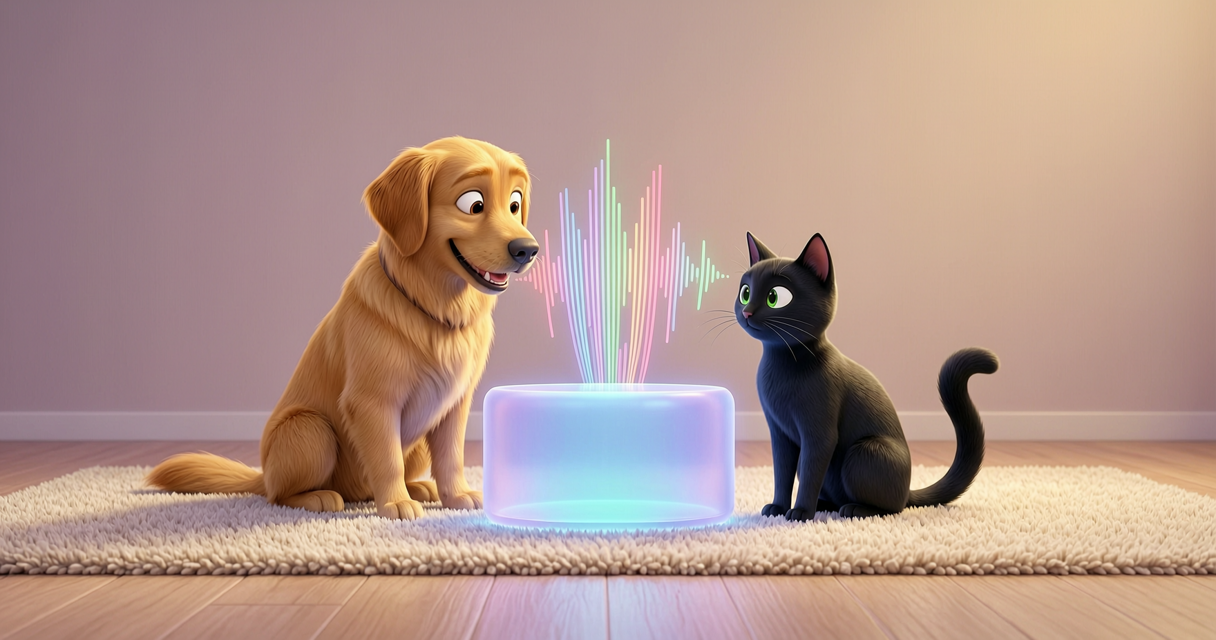
You have probably seen the viral clips: a collar that "translates" your dog into full sentences, or an app that turns a meow into "I love you." The category is booming — one Chinese startup alone pulled more than 10,000 pre-orders for a $118 AI collar. But here is the honest baseline: no consumer app truly translates animal language. The good ones categorize sounds and emotions; the rest dress pattern-matching up as conversation. This guide helps you find the genuinely free, actually-useful apps and compare them on the things that matter — without falling for a 95% accuracy claim that has no published science behind it.
We cover how these apps actually work, the best free and freemium picks for cats and dogs, a comparison table you can scan in 30 seconds, a practical comparison checklist, the free-vs-paid math, and the warning signs that an app is selling magic instead of utility.
1. What "Pet Translator" Actually Means
The word translator is doing a lot of heavy lifting in app stores. Real animal communication is not a language with grammar and vocabulary. Dogs and cats combine vocalizations, body language, scent, and context. So what these apps do is closer to classification than translation:
- Sound classification — the app assigns a recording to a broad category ("playful bark," "demand meow," "distress growl").
- Interpretation — it turns that category into a readable human phrase ("That's my toy!").
- Simulation — it plays animal sounds back or generates a playful response for entertainment.
A fluent sentence on screen does not, by itself, prove your pet said those exact words. Treat any label as a hypothesis to check against what you can observe — a dog at the door and a dog mid-play may trigger the same phrase, but the context is completely different.
None of this is science fiction — there is genuine ethology behind the idea of reading animal signals. Research from Eotvos Lorand University in Hungary showed that humans can identify emotions in dog barks even without knowing the individual animal, which suggests some canine vocal patterns are fairly universal. A separate study from Lund University in Sweden found that cats shape their meows specifically to communicate with humans: cats that live together rarely meow at each other, but they develop elaborate vocalizations aimed at their owners. These findings are exactly what app algorithms try to exploit — they correlate real vocal patterns with probable meaning. The catch is that correlation is not comprehension, and a household app is a long way from a controlled study.
The science does not support "translation," but it does support attention. Owners who use these apps tend to notice vocal patterns they previously ignored — a specific hunger meow versus an attention meow, a play bark versus an alert bark. That heightened awareness is the real, evidence-adjacent benefit, and it costs nothing but a few minutes a day.
Independent reporting puts real-world accuracy of these tools in the roughly 40–60% range for emotion categories, not the 90%+ figures some brands advertise. Academic work on acoustic-only emotion detection lands near 57%, climbing to about 89–92% only in tightly controlled, multimodal lab settings. A specific percentage with no published methodology is a marketing claim, not a measurement.
2. How the Good Ones Work
The useful apps share a transparent three-step pipeline. Understanding it helps you spot apps that overpromise.
- Frequency & pattern analysis. The app measures pitch, duration, rhythm, and tonal shape of a bark or meow. Dogs bark mostly between 500 Hz and 1.5 kHz; cats meow from 500 Hz up to 3 kHz with more complex harmonics — so cat-specific apps tune their models differently.
- AI pattern matching. Your recording is compared against a library of thousands of labeled animal sounds. The closer the match, the more confident the category.
- Context & behavioral layering. Better apps fold in body language, time of day, and your pet's history to refine the interpretation and build a per-animal profile over time.
Get more value by recording in ordinary moments, not just dramatic ones. Note what your pet was doing before you read the label, then repeat on different days. You will not prove scientific accuracy, but you will learn whether the app adds anything beyond your own eyes and ears — which is exactly the point.
3. The Best Free & Freemium Apps, Compared
Most pet-translator apps run a freemium model: a free, ad-supported core plus an optional subscription ($2.99–$9.99/month). A few are fully free with no upsell. The pills below rate the free tier's usefulness, not the paid version.
| App | Best for | Platforms | Free tier | Paid cost | Free-tier rating |
|---|---|---|---|---|---|
| MeowTalk | Cat meow categories (11 intents), per-cat voice profiling | Android, iOS | 3 basic intents free; minimal ads | ~$2.99/mo | Strong |
| Pippo | Dog emotion cards (8 moods, 40 cards) | Android | Core emotion feature free; check in-app charges | Varies / test-kit extras | Moderate |
| Dog & Cat Translator: Pet Chat | Playful simulated conversations | iOS / iPadOS | Free with ads and limits | $4.99/mo or $34.99/yr | Moderate |
| DogTok – Dog Translator | Viral, fun, social sharing | Android, iOS | Completely free, no recording limit | None (ad-supported) | Strong |
| Bowlingual | Dog emotion categories (legacy Japanese brand) | Hardware + app | Limited; older tech | ~$99 device | Weak |
| FluentPet Buttons | Dog/cat communication via recordable sound buttons (training-based) | Physical kit | No app subs; you buy the kit | ~$149 kit | Different model |
FluentPet is the odd one out: it is not an AI app at all. It is a system of physical buttons your pet presses to "say" a word you recorded. It is the most scientifically grounded communication method on this list — but it is a training tool, not a translator, and it costs money up front rather than running on a free tier.
4. How to Compare Apps Without Wasting an Evening
Use this checklist the next time you are staring at two near-identical app-store listings. The answers separate useful tools from noise.
- Does it explain what it actually does? Honest apps say "we categorize emotion" and name their inputs. Vague "AI understands your pet" copy is a yellow flag.
- What is free, exactly? Look for ad-supported core features versus a free trial that silently converts to a subscription.
- Speed and history. Good free apps process a clip in under ~3 seconds and let you keep a recent history to spot patterns.
- Species fit. Cat-specific apps (MeowTalk) beat generic ones for felines; dog-focused apps tune for bark variety.
- Privacy. Check whether recordings leave your device and what the policy says. Free often means "your data trains their model."
- Reviews with dates. Scan for recent complaints about missed captures and intrusive ads — not just the star average.
Download counts are a weak signal on their own. The most popular apps sit between roughly 100,000 and 5 million installs with star averages around 4.0–4.8, but those numbers reflect entertainment value and marketing reach as much as translation quality. A high rating from someone who "downloaded it as a joke" tells you the app is fun, not that it is accurate. Weigh the checklist above more heavily than the leaderboard.
5. Free vs. Paid: The Real Math
For most owners, the free version is enough — one industry breakdown found roughly 72% of users never upgrade. Here is what the tiers typically buy.
| Feature | Free tier | Paid tier |
|---|---|---|
| Real-time translation | Yes | Yes |
| Emotion / intent detection | Yes (basic) | Yes (advanced categories) |
| Sound history | Limited (recent 5–10) | Unlimited tracking |
| Breed / per-pet calibration | No | Yes |
| Ad-free experience | No | Yes |
| Offline mode | Some apps | Most apps |
| Price | Free | $2.99–$9.99 / month |
If your goal is entertainment and bonding, stop at the free tier. Only upgrade if you have actually used the free version for a couple of weeks and found yourself wanting unlimited history or breed calibration. Pay for a feature you use, not a promise to read minds.
6. Red Flags: When "Translator" Means "Theater"
The category attracts bold claims. Watch for these specific tells before you download or pre-order anything.
- A precise accuracy number with no method. "94.6% accurate" with no peer-reviewed study, sample size, or definition of "accurate" is marketing, not measurement.
- Claims of true two-way translation. No published study has shown an app can turn a bark into a specific human sentence with reliable meaning.
- Refusal to share testing data. Honest products tell you their limits up front; questionable ones promise the impossible.
- "Entertainment purposes only" buried in the terms. If the legal footnote contradicts the ad, believe the footnote.
- Pre-order hype from a months-old company. A startup founded in January 2026 collecting thousands of pre-orders for a "near-perfect" collar is a buzz play, not a proven product.
These apps are not veterinary or behavioral diagnostic tools. A label like "distress" is a guess from sound alone and must never replace observation or professional care. If your pet's vocalizations, appetite, or activity change sharply and persistently, contact a licensed veterinarian. Do not delay medical care because an app said your pet was "just excited." This article is general information, not medical advice.
7. How to Find and Try One in Under 5 Minutes
A safe, low-commitment routine for your first app.
- Pick by species. Cat owner → start with MeowTalk. Dog owner who wants fun → try DogTok. Dog owner curious about emotion categories → try Pippo.
- Open the official store listing. Use the exact publisher name (e.g., Island Storm Labs for MeowTalk) to avoid copycat apps with different developers.
- Confirm the free scope. Read the "In-App Purchases" line and the most recent 1-star reviews for ad and capture complaints.
- Record a calm moment first. Let your pet do an ordinary sound, read the label, and note the context.
- Repeat across situations. Compare a door-bark, a play-bark, and a rest-meow over a few days to see if patterns emerge.
- Decide after two weeks. Only then consider a subscription — and only for a feature you have actually missed.
The best free pet translator app is the one that makes you pay more attention to your pet, not the one that claims to speak for them. Use the free tier, keep your expectations honest, and let the real connection come from time and observation — not a glowing box.
Frequently Asked Questions
Can any app really translate what my dog or cat is saying?
No consumer app truly translates animal language. Dogs and cats do not use a structured language with grammar and vocabulary; they combine sounds, body language, scent, and context. The best apps classify vocalizations into broad emotion or intent categories. Treat any "translation" as a hypothesis to check against your own observation, not a literal quote from your pet.
Which pet translator app is actually free with no subscription?
DogTok (Dog Translator) is positioned as completely free and ad-supported with no recording limit, and MeowTalk offers a genuinely useful free core (three basic cat intents, minimal ads). Many others are "free to start" but gate history, calibration, or an ad-free experience behind a $2.99–$9.99/month plan. Always read the "In-App Purchases" line before installing.
Are the "95% accurate" claims true?
Not as stated. Those figures are self-reported by companies and have no published methodology, peer review, or independent lab test behind them. Independent analysis places real-world emotion categorization far lower — roughly 40–60% in everyday use, with audio-only academic detection near 57% and multimodal lab work topping out around 89–92%. A precise percentage with no公开的 testing data is a marketing claim, not a measurement.
Is a pet translator app a good gift or training tool?
For fun and bonding, yes — they encourage owners to notice vocal patterns and spend focused time with their pet. For actual communication training, a physical button system like FluentPet is more evidence-based, because the pet learns to press a word you recorded. Just keep expectations honest: neither approach is a medical or behavioral diagnostic, and neither replaces veterinary care when something seems off.


Most Read


12 Zodiac Love Compatibility: Who Is Your Ideal Partner?

How To Find Cool And Affordable Digital Display Screens For Your Car

How To Unlock Real-World Superpowers: A Practical Guide For Everyone

How To Earn Free Coins & Unlock All Rare Cosmetic Skins

How To Play Toca Life Without Downloading: A Simple Guide For All Players

How To Play Popular Switch Games For Free On Your Phone In 5 Minutes
Subscribe For New Quizzes



About us | Privacy Policy | Data Removal | Feedback
Copyright © 2019-2026 | All rights reserved.